Liquid optical adhesive
Consider wetting, adhesive thickness, material compatibility and the curing route. Liquid systems differ in chemistry and process.
Liquid adhesive and adhesive film solve different engineering problems. The right choice starts with the surfaces, materials and operating conditions in your display stack.
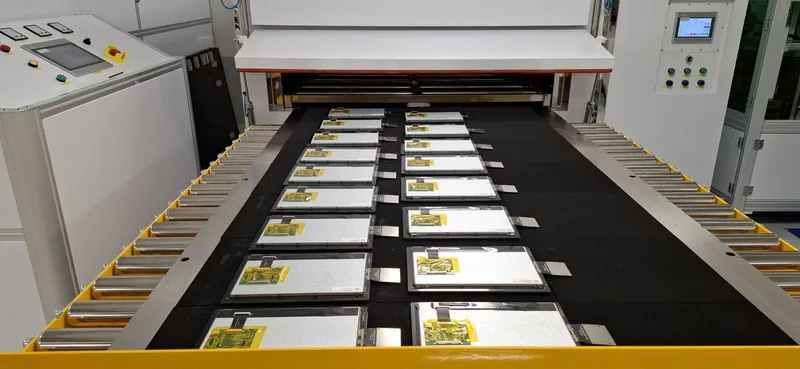
*Diagonal scope. Dimensions and stack suitability require technical assessment.
LOCA uses a liquid optically clear adhesive; OCA is supplied as an optically clear adhesive film. Material chemistry, application method and curing or lamination conditions vary between systems. Neither label alone establishes durability, optical performance or reworkability. The proposed route needs to be checked against the actual components.
Consider wetting, adhesive thickness, material compatibility and the curing route. Liquid systems differ in chemistry and process.
Consider surface flatness, lamination conditions, alignment and the tolerances of the complete stack.
Temperature cycling, glass expansion, optical requirements and assembly handling influence the choice.
A soft, index-matched gel can suit a bond that must stay flexible under thermal stress, while pre-cut dry material can suit a defined, recurring display size. Each route carries different rework and tolerance implications.
Explore this topicA useful specification reduces uncertainty and gives the technical review a clear starting point.
No universal guarantee applies. Rework depends on the adhesive system, construction, age and condition of the assembly.
No. Some systems may permit rework; others may not. An existing assembly needs individual assessment.
Size is one factor among several. A liquid adhesive tends to suit larger or curved surfaces; film tends to suit flatter, high-volume production — but the complete stack still needs individual assessment.
Share the display details, the environment and the project timeline.
Discuss your project