Sunlight across a glazed cab
A fully glazed cab means sunlight strikes the display almost head-on. Removing the internal air gap addresses one source of the internal reflections that would otherwise wash out the image.
Tractors, excavators and harvesters put a cab display through direct sun across a fully glazed cab, constant vibration and wide daily temperature swings.
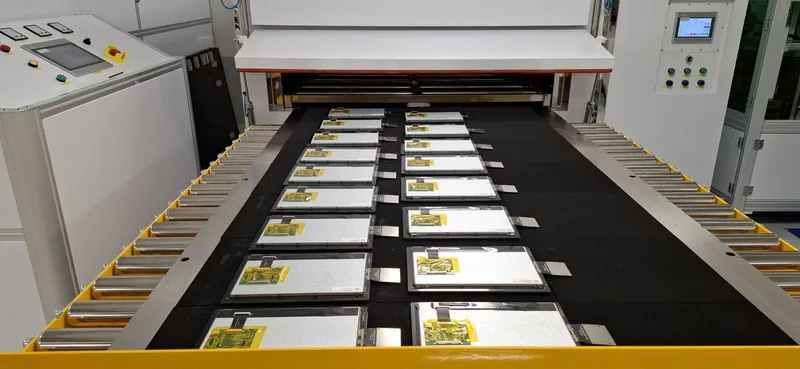
*Diagonal scope. Dimensions and stack suitability require technical assessment.
A fully glazed cab means sunlight strikes the display almost head-on, and engine or terrain vibration can fatigue an unbonded cover glass over time. Once dust or moisture reaches an open air gap it is effectively impossible to remove. Optical bonding fills the air gap completely, turning cover glass, touch sensor and display into one mechanically stable unit.
A fully glazed cab means sunlight strikes the display almost head-on. Removing the internal air gap addresses one source of the internal reflections that would otherwise wash out the image.
Engine and terrain vibration can fatigue an unbonded cover glass over time. A bonded assembly is reviewed against the relevant vibration and impact profile rather than relying on a loose air gap.
Once contamination reaches an open air gap it is effectively impossible to remove. A sealed, bonded front together with the right housing and gasket design is reviewed to resist dust ingress and pressure-washing.
Explore this topicA useful specification reduces uncertainty and gives the technical review a clear starting point.
Full-surface lamination creates a composite block similar in principle to laminated safety glass. Impact resistance can improve, and the adhesive layer can help hold fragments in place if the glass is damaged — the result depends on the complete stack.
That depends on the gasket and housing design matched to it. Bonding creates a sealed front, but the achievable protection class depends on the complete sealing concept, not the bond alone.
Share the display details, the environment and the project timeline.
Discuss your project