Reference · Terms used across this site

Glossary of optical bonding terms

Optical bonding brings together display, materials and manufacturing vocabulary. This glossary explains the terms used across this site in plain language, without presenting them as measured results for a specific project.
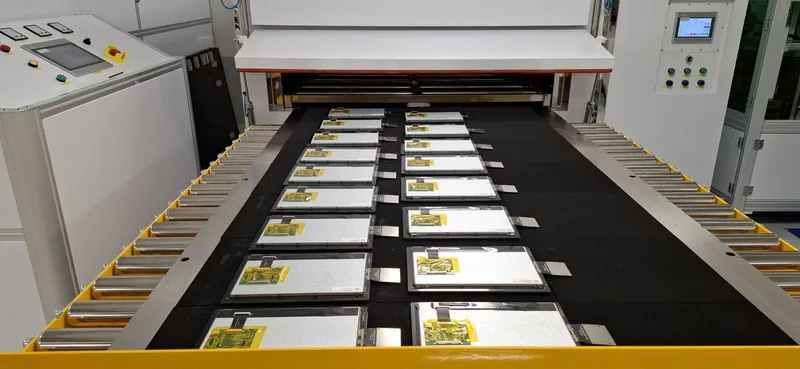
Electronic components on a production transport line
DISPLAY ENGINEERINGOPTICAL BONDING PRO
UP TO 59 INCHES*APPLICATION-LEDPROTOTYPE TO PROJECT PLAN

*Diagonal scope. Dimensions and stack suitability require technical assessment.

The project perspective

A shared reference, not a specification

These are general industry and physics terms used across optical bonding literature. They support reading the rest of this site; they do not replace a project-specific technical review.

LOCA and OCA

Liquid and film adhesive routes for optical bonding, each suited to different display geometries and production volumes.

Explore this topic

PCAP and parallax

Capacitive touch sensing and the visual offset that optical bonding is designed to help reduce.

Explore this topic

IK and IP ratings

Impact and ingress classifications that describe the complete assembly, not the glass alone.

Explore this topic

Cleanroom and ESD

The controlled manufacturing conditions bonding is carried out under.

Explore this topic

A

Air Bonding
Securing the cover glass and display only at the edges with tape, leaving the air gap unfilled. It is a lower-cost alternative to optical bonding that keeps the air gap’s reflections, condensation risk and mechanical weakness in place.
Air Gap
The cavity between a display and its cover glass in a non-bonded assembly. Because glass and air have different refractive indices, each interface reflects some of the incoming light; across a multi-surface stack this can reduce perceived contrast and brightness. The air gap is also where condensation and dust tend to collect.
Anti-Glare Coating (AG)
A matte finish created by etching or sandblasting the glass surface. It scatters incoming light to reduce mirror-like reflections, at some cost to image sharpness, and is often combined with optical bonding for outdoor readability.
Anti-Reflective Coating (AR)
A multi-layer thin-film coating that uses interference to reduce surface reflection. It only addresses the outer glass surface; internal reflections from the air gap remain unless combined with optical bonding.

B

Bonding Autoclave
A pressure chamber used after OCA lamination to press out remaining micro-bubbles and improve adhesion. A standard step for OCA; generally not required for LOCA.
Bonding Yield
The share of displays bonded without defects in series production. The achievable value depends on the product, materials, process and inspection limits, and is assessed per project rather than quoted as a universal figure.
Refractive Index
A measure of how much a material slows down light passing through it. Glass and air have different refractive indices; LOCA and OCA adhesives are formulated to sit close to glass, which is what removes the optical interface at the air gap.

C

Cleanroom
A controlled manufacturing environment with a defined limit on airborne particles. Cleanroom conditions can reduce the risk of particle inclusions during bonding; the class actually required depends on the product and process. Explore this topic →
Condensation (Fogging)
Moisture condensing inside the air gap between display and cover glass as temperatures change, leaving the display misty or hard to read. Optical bonding removes the cavity where condensation would otherwise form.
Contrast Ratio
The ratio between a display’s brightest white and darkest black. Reflections inside an unbonded stack can reduce effective contrast outdoors; optical bonding, often combined with an AR coating, addresses one cause by removing internal reflective interfaces. The achievable result depends on the complete stack.
Cover Glass
The outer protective glass over the display and touch sensor, typically chemically strengthened. It may carry anti-reflective, anti-glare or anti-fingerprint coatings, and is bonded directly to the display in an optical bonding process. Explore this topic →
CTE (Coefficient of Thermal Expansion)
A measure of how much a material expands or contracts with temperature. Glass, adhesive and display materials typically have different CTE values, which can create mechanical stress across temperature cycles — a factor in material selection for wide operating ranges.

D

Delamination
Separation of the adhesive from a bonded surface, visible as cloudiness, bubbling or a gap at the edge. Usually caused by inadequate surface preparation, incompatible materials or thermal overload.
Display Stack
The complete set of layers in a display assembly: cover glass, touch sensor, bonding layer, panel and backlight. Optical bonding joins these into a single, optically and mechanically unified unit.

E

EMI Shielding
Protection of the display stack against electromagnetic interference. Conductive coatings or metal mesh films can be integrated into the bonded stack without compromising optical clarity, where EMC requirements apply.
ESD Protection
Measures against electrostatic discharge, which can damage display electronics and touch sensors. In cleanroom bonding this covers conductive flooring, ESD clothing and ionised air; in the finished product, ESD-dissipative seals or coatings.

G

Grey Gap
A lifted black level caused by light scattering and reflecting within the air gap, so black areas of the screen appear grey rather than true black. Optical bonding reduces the grey gap by removing the internal air gap; the achievable improvement depends on the specific stack and is not a fixed figure.

H

HMI (Human Machine Interface)
A control and display device fitted to machinery, plant or vehicles, typically a PCAP touchscreen with a robust cover glass. Optical bonding is common practice for industrial HMIs, where readability, glove operation and resistance to dust and vibration are all required at once. Explore this topic →

I

IK Rating (Impact Protection)
A classification under IEC 62262 for resistance to mechanical impact, from IK00 (no protection) to IK10. Optical bonding can support a higher effective IK rating for the complete assembly by creating a single, more impact-resistant structure; any specific rating depends on housing, glass and mounting, and should be verified through testing. Explore this topic →
IP Rating (Ingress Protection)
A classification under IEC 60529 for protection against solid objects and water — for example, IP65 means dust-tight and protected against water jets. Optical bonding helps protect the display interior from dust ingress and supports higher IP ratings when combined with appropriate sealing.
ITO (Indium Tin Oxide)
A transparent, electrically conductive material used as the electrode layer in PCAP touch sensors. ITO-on-glass is the standard sensor material for capacitive touchscreens.

L

LOCA (Liquid Optically Clear Adhesive)
A liquid, optically clear adhesive used in optical bonding. Dispensed while liquid, it self-levels across the surface and is cured under UV light, and tends to suit larger, curved or uneven displays, and applications where rework may be needed. Explore this topic →

N

Nit (cd/m²)
A unit of display brightness; one nit equals one candela per square metre. How much brightness a project needs for outdoor readability depends on the display, coatings and installation, and is assessed per project rather than by a fixed figure. Explore this topic →

O

OCA (Optically Clear Adhesive)
A pre-manufactured, optically clear adhesive film of defined thickness, applied by vacuum lamination and typically finished with an autoclave step. It offers consistent thickness and fast cycle times, and tends to suit flatter displays in series production; reworkability is more limited than with LOCA. Explore this topic →
Optical Bonding
A manufacturing process that fills the air gap between display, touch panel and cover glass with a fully transparent adhesive (LOCA, OCA or optical gel). Matching the refractive index across the stack removes internal reflective interfaces, which can support sunlight readability, reduce condensation risk and lower parallax error — the achievable result depends on the complete stack. Explore this topic →
Optical Bonding vs. Screen Protector
A screen protector guards only the outer surface against scratches, and adds another reflective interface. Optical bonding takes a different approach: it bonds every layer of the display stack into one optically continuous unit. The two are not mutually exclusive.
Optical Gel
A soft, gel-like bonding layer matched to the refractive index of glass, used for a bond that must stay flexible or remain non-permanent. It has lower mechanical strength than LOCA or OCA, but can be removed without residue where a display needs to be disassembled. Explore this topic →

P

Parallax Error
The visible offset between where a cover glass is touched and where that touch registers on the display content, caused by the gap between touch sensor and panel. Optical bonding removes the air gap and can reduce parallax error close to zero. Explore this topic →
PCAP (Projected Capacitive Touch)
Capacitive touch sensing using a grid of transparent ITO electrodes. It supports multi-touch, glove operation and water resistance, and tends to perform best in combination with optical bonding, which helps reduce parallax error. Explore this topic →
Plasma Treatment
Cleaning and activating glass surfaces with ionised gas before bonding. It removes organic contamination and increases surface energy, improving adhesive wetting and bond strength.

R

Rework / Reworkability
The ability to separate a bonded display without destroying it, replace a component and re-bond it. This depends on the specific adhesive, construction, age and condition of the assembly rather than a general rule. Explore this topic →
ROI (Return on Investment)
A project-specific measure of the financial case for optical bonding, weighing potential savings against the additional cost of the bonding step. A reliable figure depends on real usage, failure and cost data for the specific project. Explore this topic →

S

Sunlight Readability
A display’s ability to remain clearly readable in direct sunlight. It depends on brightness, contrast ratio and reflectivity together; optical bonding addresses the reflectivity factor by removing internal reflections. Explore this topic →

T

TFT-LCD (Thin Film Transistor Liquid Crystal Display)
A liquid crystal display using thin-film transistors to switch each pixel — the standard display technology for industrial, medical and outdoor applications. In an optical bonding context, this is the panel joined to the touch sensor and cover glass.

U

UV Curing
The photochemical process that hardens LOCA adhesives. UV light activates photoinitiators, triggering the curing reaction; UV dose is monitored and recorded as part of batch documentation.

V

Vacuum Lamination
A bonding method where the display and cover glass are joined inside an evacuated chamber, preventing trapped air in the adhesive. A standard step in optical bonding, supporting bubble-free bonds even on larger display formats.
Before the first review

What to put in your brief.

A useful specification reduces uncertainty and gives the technical review a clear starting point.

  • Whether an unfamiliar term in your own specification is used as vocabulary or as a claim of conformity
  • Any figure or range relied on from a supplier quote or datasheet
  • Bring any term you are unsure about to a technical review
Questions worth asking

Clear scope. Clear expectations.

Are the figures in this glossary Optical Bonding Pro’s own measured results?

No. These are general industry and physics terms used across optical bonding literature, not production specifications or a guaranteed outcome for a specific project.

Your application. Your requirements.

Make the next step specific.

Share the display details, the environment and the project timeline.

Discuss your project