Surface treatment
Separate anti-reflective and anti-glare requirements. Surface texture and optical coating are different approaches.
The cover glass shapes appearance, protection and interaction. Treat its material, coating and geometry as engineering decisions from the outset.
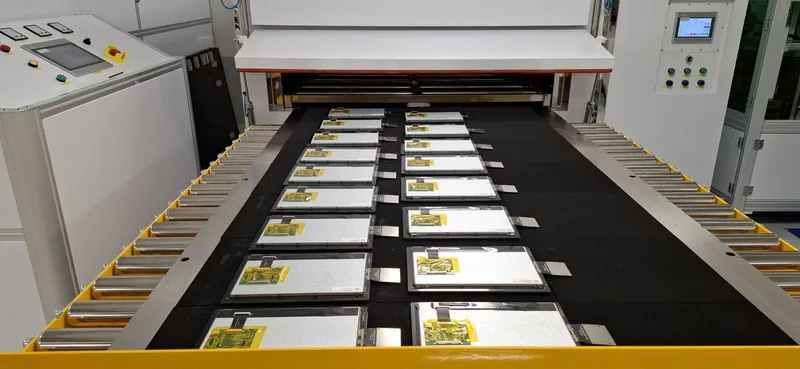
*Diagonal scope. Dimensions and stack suitability require technical assessment.
A cover-glass drawing should identify outside dimensions, thickness, edge treatment, holes or apertures and any printed or coated areas. Surface treatment can change optical behaviour and adhesive compatibility. The complete enclosure remains responsible for sealing and mounting; bonding alone does not establish an IP or impact rating.
Separate anti-reflective and anti-glare requirements. Surface texture and optical coating are different approaches.
Identify opaque borders, logos, apertures and the areas that must stay optically clear.
Define edge support, clearances, seals and mounting loads in the final assembly.
Float glass, chemically strengthened glass, borosilicate and sapphire each trade off strength, temperature resistance and cost differently. The right material depends on the application, not a single default.
Explore this topicA useful specification reduces uncertainty and gives the technical review a clear starting point.
Thickness influences weight, stiffness, touch response and handling. The appropriate choice depends on the complete assembly.
Yes. Adhesion and optical compatibility should be checked for the actual coating and adhesive system.
Not on its own. An IK impact rating under IEC 62262 describes the complete assembly and mounting, not the glass alone — glass choice, adhesive and housing need to be assessed together.
Share the display details, the environment and the project timeline.
Discuss your project