Fixed machine HMIs
Consider hall lighting, cleaning agents, panel mounting and expected service life.
A machine interface must stay readable and usable throughout a working shift. Define its light, contamination and operator requirements before selecting the front assembly.
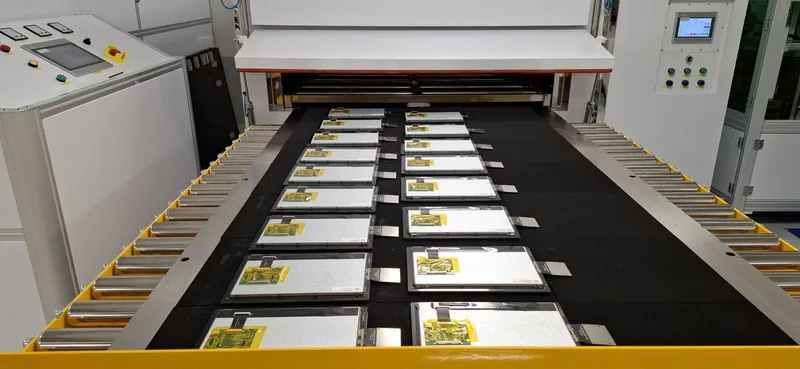
*Diagonal scope. Dimensions and stack suitability require technical assessment.
An HMI on an indoor machine differs from a mobile control panel used outside. Oil mist, vibration, changing illumination and gloves all affect the brief. Optical bonding can address internal reflections and the air gap, while the enclosure, seals and touch system need their own assessment.
Consider hall lighting, cleaning agents, panel mounting and expected service life.
Specify sunlight, handling, cable movement, vibration and the operator’s gloves.
State the viewing distance and display dimensions. Projects up to 59 inches diagonal are subject to stack assessment.
Where an emergency stop, enable switch or mode selector sit close together, reduced parallax can lower the risk of the wrong control being triggered. This matters more on a safety-relevant panel than a cosmetic one.
A useful specification reduces uncertainty and gives the technical review a clear starting point.
It removes the optical air gap where present. Device-level protection still depends on the enclosure, seals and compatible materials.
Share its display, touch and mechanical details. A review can establish whether the existing front or a new design is the better starting point.
Yes. A handheld robot-controller or teach-pendant interface raises the same parallax and shock-resistance questions as a fixed machine HMI and can be reviewed under the same assessment.
Share the display details, the environment and the project timeline.
Discuss your project