Cleaning and disinfection
Identify substances, concentrations, contact time and the expected cleaning cycle.
Medical interfaces combine optical clarity with cleaning, interaction and product-specific validation requirements. These should be specified together.
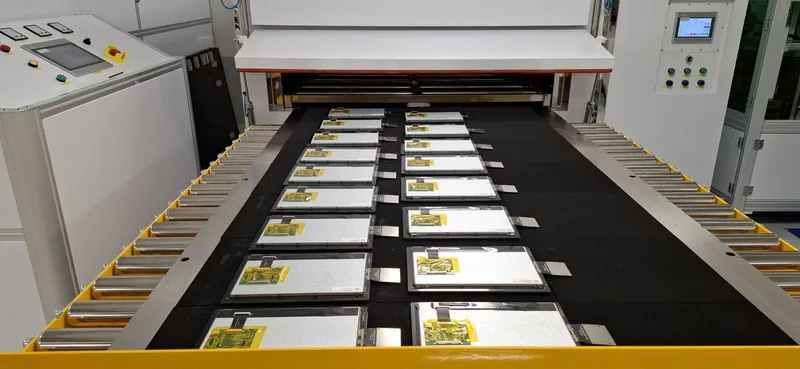
*Diagonal scope. Dimensions and stack suitability require technical assessment.
Optical bonding can reduce internal reflections and support a continuous front-assembly design. It does not establish medical-device conformity, diagnostic accuracy or compatibility with every disinfectant. The product team must define applicable requirements, cleaning chemicals and validation criteria for the intended device.
Identify substances, concentrations, contact time and the expected cleaning cycle.
Define the intended use, viewing conditions and any display-specific calibration or image-quality requirements.
Specify gloves, moisture, UI targets and the controller setup used in the final product.
Laboratory analysers and point-of-care devices face similar cleaning-cycle and glove or stylus operation requirements. The same front-assembly considerations apply, reviewed for the specific instrument.
A useful specification reduces uncertainty and gives the technical review a clear starting point.
No. Compliance and product validation involve the complete device and the manufacturer’s requirements.
No general compatibility applies. The specific chemicals and materials must be assessed.
It removes one collection point between bezel and display, but resistance to a specific disinfectant depends on the chosen coating, adhesive and seals, and needs its own validation.
Share the display details, the environment and the project timeline.
Discuss your project