Internal reflections
Assess the layers and air gaps between the display, sensor and front glass.
A bright panel can still be difficult to read outside. Review the display’s emitted light and reflected ambient light as parts of the same problem.
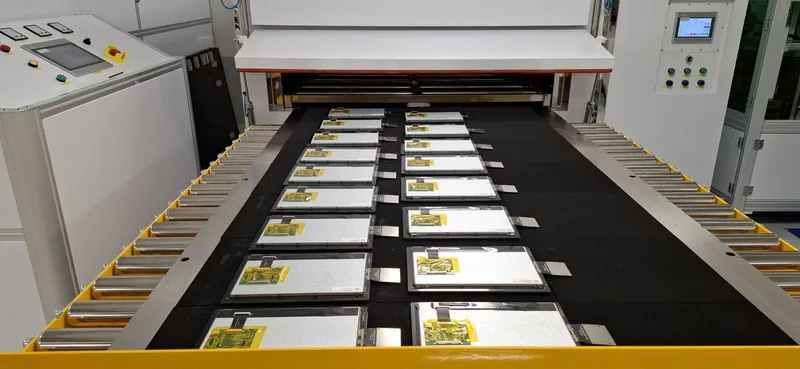
*Diagonal scope. Dimensions and stack suitability require technical assessment.
Air interfaces within the display stack can reflect ambient light and reduce perceived contrast. Optical bonding can reduce these internal reflections. The visible surface, cover treatment, viewing angle and ambient conditions still influence readability. Define the actual use case before specifying brightness or making performance claims.
Assess the layers and air gaps between the display, sensor and front glass.
Review anti-reflective or anti-glare treatment and its effect on the visible image.
Consider solar heating, operating temperature, sealing and the enclosure as well as optics.
A useful specification reduces uncertainty and gives the technical review a clear starting point.
No. The measured effect depends on the starting stack, surface treatment and test conditions.
Not necessarily. Required brightness and reflected light should be assessed together for the application.
No. It can improve mechanical stability compared with an unbonded front, but it is not a substitute for a dedicated security-glass concept where vandalism risk is high.
Share the display details, the environment and the project timeline.
Discuss your project